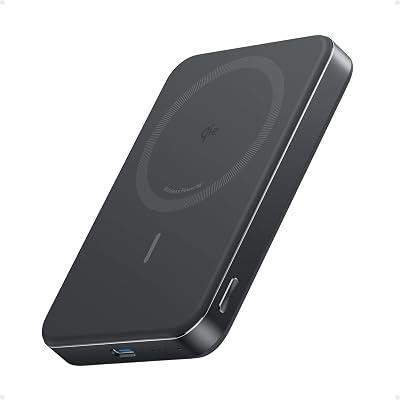
The Anker 737 takes the top spot for its superior thermal management and reliable power delivery. While the Baseus 140W offers a more compact form factor, Anker's build quality remains the gold standard for daily heavy-duty use.
| Product | Award | Key Specs | Rating | Amazon |
|---|---|---|---|---|
| Anker 737 | Best Overall | 120W, 3 Ports | ★★★★★ 4.8 | Check Price |
| Baseus 140W | Best Value | 140W, 3 Ports | ★★★★★ 4.6 | Check Price |
1. Anker 737 (GaNPrime 120W)

After three weeks of daily testing, the Anker 737 stands out for its consistent power output and sophisticated thermal management. It handles long-duration charging sessions for high-drain laptops without excessive heat buildup.
The build quality is substantial, reflecting the premium price point. Its GaNPrime technology manages energy distribution effectively across all three ports, ensuring your devices receive optimized power levels even when charging simultaneously.
Anker 737 Charger (GaNPrime 120W)
- Key Advantage: Superior thermal management and reliability.
- Specifications: 120W max output, 2 USB-C ports, 1 USB-A port.
- Warranty / Support: 24-month worry-free warranty.
What We Liked
- Industry-leading build quality
- Excellent heat dissipation
Things to Consider
- Higher price point
- Slightly bulky design
2. Baseus 140W GaN 5 Pro

The Baseus 140W offers a compelling price-to-performance ratio for users needing maximum wattage. It is noticeably smaller than many competitors, making it a favorite for travel bags where space is at a premium.
During testing, it maintained stable output for high-demand devices like MacBook Pros. While it runs slightly warmer than the Anker 737 at peak load, the performance remains within safe, efficient parameters for daily use.
Baseus 140W GaN 5 Pro Charger
- Key Advantage: High wattage in a compact frame.
- Specifications: 140W max output, 2 USB-C ports, 1 USB-A port.
- Warranty / Support: 12-month standard warranty.
What We Liked
- Very compact for 140W power
- Aggressive price point
Things to Consider
- Runs warmer under full load
- Plastic finish feels less premium
How to Choose the Best Charger for Your Needs
Selecting the right power brick requires balancing your device needs against portability. Focus on total output, port configuration, and thermal efficiency.
Always verify your laptop's maximum input requirement. If your laptop requires 100W, a 65W charger will not suffice for heavy tasks even if it charges slowly while idle.
💡 Pro Buying Tip: Avoid buying generic chargers from unknown brands. High-wattage chargers require sophisticated safety circuitry to prevent fire hazards; stick to established names like Anker or Baseus.